Tag: family

  • Bonnies & Books (1977-1985)

    My mom’s best friend was named Bonnie Jameson. She drove a beat up, blue VW van with personalized license plates that read BONIBUS and I was named after her. Bonnie and my mom became best friends in seventh grade, when Bonnie’s family moved to mom’s hometown of Escalon. Until Bonnie’s near-miraculous arrival, mom seemed destined to the life of the weird-loner-library-girl. In fact, Bonnie and mom were introduced by the Escalon librarian, who surreptitiously allowed my mom to select books from the adult section of the library as long as she didn’t tell the other kids or, presumably, my grandparents. Anyway, one day my socially awkward mom showed up at the library and the librarian thrust an equally awkward girl who liked books in my mom’s direction and their friendship fate was sealed.

    They grew up. They dated, married, and lost husbands together. They bore children at about the same time. Bonnie and my mom even found and subsequently rejected Jesus during the same whirlwind period that began with the release of the film Jesus Christ Superstar and ended after three years of weekly bible study left them too skeptical to continue. Honestly, I think their innate skepticism surfaced a lot earlier than three years, but in the meantime they had both developed a serious crush on the local Methodist minister, Don Nelson. Don was tall, dimpled, and drove a red convertible. Even I wrote love songs about the guy when I was little. True story.

    Bonnie had four children and there were three in our brood, and the nine of us constituted one big family for the formative years of my youth. Dads were strictly peripheral. These were the golden years of childhood, the 1970s, before play dates and time outs, when we all ran feral and were spanked in public if we didn’t stay sufficiently under the radar. If you didn’t get your ass publicly beat in Mervyns, you probably didn’t grow up in Modesto in the 1970s. These were the days when half a dozen kids piled into the backseat of the family Malibu sans seatbelts, high on Sugar Babies and rocking out to “Delta Dawn” on the 8-track. We inhaled clouds of second-hand smoke our moms blew through Revlon’d lips as they talked shit about our dads or discussed Burt Reynolds’ Cosmo layout.  I’m ashamed at how uncool my daughter’s own childhood was in comparison to mine. There is something to be said for a feral upbringing.

    Every summer our two families hosted these epic picnics out at Woodward reservoir called the Looney Picnics, a combination of both their first names (Lucille + Bonnie). This was before both MADD and SPF and I remember all the adults (and young adults) getting way too smashed and all us smaller kids suffering ferocious sunburns. Mom and I would spend the entire next day in her darkened bedroom watching daytime tv, me covered in Noxzema and mom nursing her Lucky Lager hangover. The smell of Noxzema still conjures for me the theme song from The Carol Burnett show, the prickly feel of my parents’ wool bedspread on my blistered legs and back, my mom and I whimpering softly in unison as we nursed our respective hurts.

    When Bonnie’s third marriage ended, she had to find work. The local shopping mall had just opened and Bonnie secured a job at Waldenbooks, where she eventually worked her way up to assistant manager. This proved most advantageous to my mom and me, both voracious readers.  In fact, it’s safe to say Bonnie’s tenure at Waldenbooks shaped my entire literary pathology in a very distinct way. It may have shaped the entire trajectory of my life, though I’m more apt to say that when I’ve smoked a little lady pot and am thinking too much about the past.

    Back then there were two thriving bookstores in the Modesto mall, Waldenbooks and Stacey’s. These bookstores didn’t want to shoulder the expense of sending unsold stock back to the warehouse. If a title was languishing on the shelf, employees would merely rip off the cover and send it back to the district office, while recycling the actual book. This kept the branch happy, HQ happy, and my mom and I the happiest of all. Because, of course, this meant that Bonnie would make frequent deliveries of coverless books to Tahoe Drive. A lot of books were recycled via our house. One paper sack full for me, one for my mom, every two weeks like clockwork.  I’d guess this started in the late seventies and went on for at least 7 years. It definitely got me through junior high and most of high school. I didn’t have a lot of friends in 7th grade, but I had piles of Paul Zindel, Katherine Paterson, and Paula Danziger.

    Every few weeks I’d walk into the house after school to the smell of coffee, the sound of laughter coming from the kitchen. Bonnie and my mom laughed a lot and they spoke the intimate language of female friendship. To my poor dad it was like they were speaking in a purposely exclusive code, but that wasn’t it. They simply knew each other’s stories so intimately. Bonnie would mention her sister and mom would make a vague reference to vacuum cleaner trauma and they’d both explode into peals of laughter at some memory that belonged only to them.

    Anyway, I’d round the corner from the front door and there they’d be: two brown grocery bags tucked neatly around Bonnie’s feet, brimming with paperbacks. I’d take my designated bag to my room immediately, loving the way it felt in my arms: knobby, substantial and full of promise. I kept the bag next to my bed and dipped into it like it was a bag of potato chips, all blind reach with no need for selection. Most of the books were the same size and, without their covers, there was no real reason to prefer one over another. Most of them I liked. Some I loved so much I’d carefully set them aside to reread later. Some were mundane and I forgot them immediately. But I read them all, without fail, one right after another. Just when the bag was getting soft and shiny with wear, torn in places and near-empty, Bonnie would show back up with reinforcements.

    When I got older, my mom and dad would travel in the summer and I’d stay with my grandparents. Without Bonnie to sustain me, I’d attack my grandma’s bookshelf like it was that grocery bag of books, pulling titles from the shelf and reading them all, without fail, one right after another.  James Herriot, Corrie Ten Boom, James Michener, John Steinbeck. I’m just sure I was the only one in my social circle reading the Lyndon B. Johnson biography in eighth grade because by then I was a book junkie, and Robert Caro was the only drug available to me the summer my parents went to Egypt.

    All these years later, I still do best with a haphazard collection of books. I actually delight in such collections. Stick me in an Airbnb and I’ll chew through every title on the bookshelf, one by one, with a singular determination. I’ll read the cheesy horror book about the flesh-eating vines in Mexico, then move onto the biography of some random captain of industry, and happily finish with a rereading of Wuthering Heights. When we rented a boat in Ireland in 2018, the marina office had a small library and I was totally in my element. I just scooped up the first linear foot of books and read them all like a bibliographic Terminator as we navigated the Shannon-Erne Waterway.

    Reading isn’t a problem for me. As long as I don’t have to decide what to read. Deciding is my Achilles’ heel.

    If you put me in a bookstore, no matter how lovely it is – with a fat, striped cat curled up on the counter and that delicious smell of paper and ink permeating the air – I’ll simply freeze up. Oh, I’ll look at everything, but will very likely leave empty handed. Libraries are even worse. Yes, I’m a librarian and I just said that. I will wander the stacks for hours, too stunned by the selection to make a choice. I’ve tried to have librarians choose for me, but that doesn’t work either because they want to work their Reader Advisory magic. When they ask, “What kind of books do you like?” I am too embarrassed to answer. Because, apparently, I like the kind of books that magically appear in a paper bag in my kitchen. I like the books that are sitting on a shelf in your spare bedroom. I like the books travelers discard on their journey to make room for cheap souvenirs. If that’s not yet a literary genre, maybe it should be?
  • Dendrophilia I: Black Plum (1970s)

    The plum tree stood sentry on the northeastern edge of my grandparents’ one-acre spread, on a narrow stripe of land nestled between the property line and the dirt driveway into the garage. Years before a pile of sand had been dumped beneath the tree when pavers were installed between the kitchen and the shop. Over time, the pile of sand had been dipped into, tramped over, and prodded by wind and rain so that it was barely perceptible. We knew it was there, of course, and if anybody needed sand for a project, they would take coffee can or bucket on over to the plum tree and help themselves. If you were a kid as dedicated to making mud pies as I was, having a secret stash of sand on the property was a boon for many advanced recipes.


    Much like a good cat, a good plum picks you. But you must pay attention. I spent many summer days during my childhood lazing in the shade with my grandfather with little to do but stay cool and listen for plums hitting the ground. My grandparents were dirt farmers who moved to the San Joaquin Valley from west Texas in 1934 with the singular goal of not starving to death. As it turns out, poor people from west Texas know how to stay cool in the absence of air conditioning, namely by staying as still as you can and developing a healthy relationship with the shade. Iced tea helps, too. My grandpa and I were expert still stayers. Professional shade chasers. World champion drinkers of sweet tea.


    My grandparents had a large expanse of lawn fronting the haphazard row of buildings that made up their modest property. West of the garage was a hexagonal building we called the round house, then came my dad’s L-shaped shop, and then, set back from the other buildings, a modular structure nicknamed the bunk house because that’s where my aunt and uncle would bunk down during their epic visits every four years or so. The two-bedroom main house was the last building in the line, and beyond it lay the permanent garden. There was another seasonal garden that spanned the width of the property behind the outbuildings, but the area fronting the structures was 100% dedicated to shade.


    Where the lawn met the road, a box hedge provided a barrier between the house and Lemon Avenue, because people drive down country roads at crazy speeds. My grandma used to threaten to lay a long 2’x4’ across the street because “that would teach them to slow down.” She would say this with genuine eagerness, like she really wanted to do it. I think I inherited my biblical retribution streak from my Grandma. Anyway, the lawn and hedge were bisected right up the middle by a second, paved driveway. While the dirt driveway led into the garage and was for the exclusive use of my grandfather’s blue 1967 Chevelle, the paved driveway dead ended into my dad’s shop and was the “company driveway.” As in, that’s where company parked. My dad, who ran his television repair service out of my grandparent’s home, also parked his work van there when he dropped by to pick up messages or to eat lunch.


    The lawn was shaded by two massive shade trees. The trees were there when my grandparents acquired the property back in the 1940s, and the house and other structures had been built around these giants. It was under these magnificent trees that my grandfather and I would take our extended afternoon siestas after mornings filled with gardening, fort-building, and mud-pie making. I’d typically curl up on a lounger with a book, while my grandfather was content to settle into his own thoughts. The valley heat can be thick and oppressive, but the trees were big enough to catch all sorts of subtle breezes and deliver them down to our damp necks. 


    Even while we enjoyed our companionable silence, the world around us was alive with sound. The buzzing of honeybees, bumblebees and hummingbird wings drifted over from the flower beds that edged every building. Mockingbirds and scrub jays would square off in the branches above our heads, screeching at each other and hopping strategically from branch to branch. Sometimes we’d hear the intermittent sound of a sprinkler or farm equipment in the distance, or the neighbor’s dog Dolly barking at the gophers who ran riot in the peach orchards across the street. And, of course, the sound of ice cubes clinking when one of us would pick up or set down our glasses. It was from this medley of sounds a plum would call out to be eaten.


    A soft, dull thump as a piece of fruit became so heavy with juice that the stem would give way, delivering a black plum onto the sandy ground below. Quickly, fluidly, I’d slip from the lounger and head toward the tree. The secret was to find the plum before the birds discovered it, before the insects. A properly ripe plum is so purple it appears almost black, with a pale dust over the skin like a lavender scarf. This dust is called the bloom, which is sort of lovely, right? The skin of the plum is tart, but the white flesh beneath is as sweet as sugar. And warmed by the summer sun, there are few things better.

    These days I feel about grocery store plums the way most people feel about grocery store tomatoes. At the risk of sounding like a fruit snob, grocery store plums are nothing like real plums. Sometimes I think that if the day ever comes when I bite into a real plum again – sweet as cane sugar and warmed by the summer sun – I just might time travel back to that shady lawn with my grandpa next to me and a fruit-stained Judy Blume book in my hands. And maybe I’ll never come back.

  • A Gift from My Mother (Spring 2026)

    A Gift from My Mother (Spring 2026)

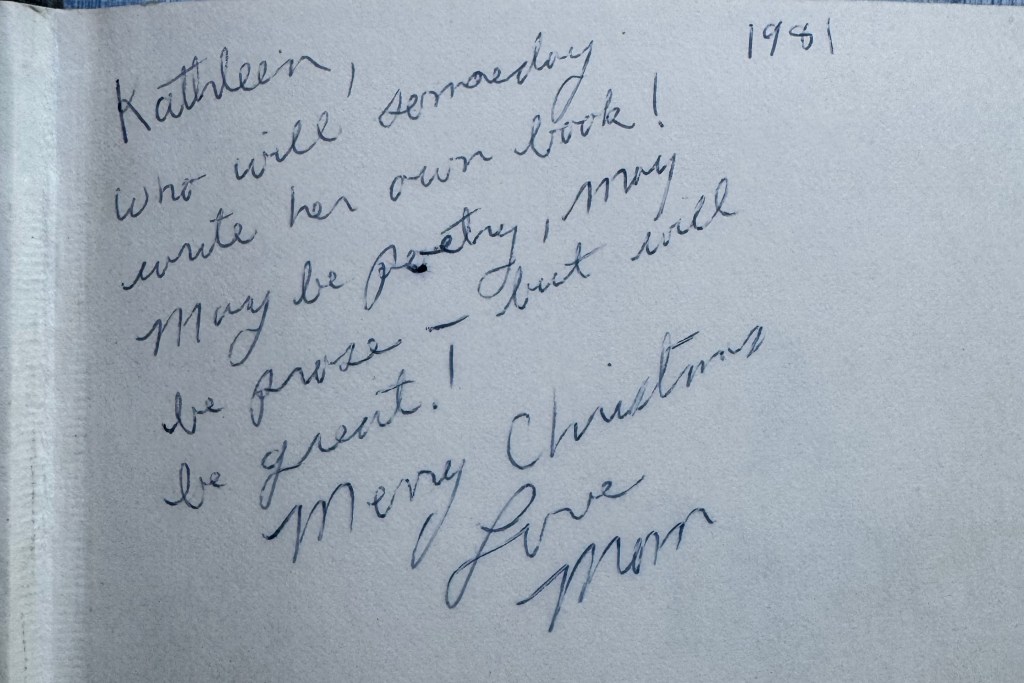
    The other day I was browsing through my bookshelves for suitable vacation reads when I came across my childhood copy of Shel Silverstein’s A Light in the Attic. I flipped it open and there, on the flyleaf, was my mom’s familiar handwriting: It was dated 1981.

    For Kathleen, who will someday write her own book!  May be poetry, may be prose —but will be great! Merry Christmas Love, Mom

    I had won some sort of writing competition at Somerset Junior High earlier that year.* There was an evening ceremony where I was presented with a Webster’s dictionary for my efforts, along with an appropriately fancy certificate. Both are long gone now. But, boy, was my mom excited.

    In truth, she was far more excited than I was.  I was so fucking awkward in seventh grade that the last thing I wanted to do was walk across the gymnasium and shake hands with my creative writing teacher and the principal. I was convinced this was yet another nail in my popularity coffin. But mom beamed proudly through the awards ceremony and even dragged my dad along.

    At Christmas the book of poetry was wrapped and waiting under our tree. I was a huge Shel Silverstein fan after three consecutive years of Mr. O’Grady’s language arts classes in elementary school. Mr. O’Grady read all sorts of novels to us, but he read from Silverstein’s Where the Sidewalk Ends like it was scripture. Regularly, reverently. I promise you, every single kid who had Mr. O’Grady at Standiford School knows who Sarah Cynthia Sylvia Stout is. My own copy of the newly published Light in the Attic was way cooler than winning the award. And, yeah, I still have the book.

    Fast forward thirty-five years. My mom is in the local emergency room, her third or fourth visit in a two-month span. She has congestive heart failure, and this isn’t going to end well for her and we all know it. These regular trips to the ER were stressful and frightening for all of us, but especially my mom, who was in a showdown with her own mortality. I remember following her into the house after one of these ER stays. She was moving slowly, gingerly, and suddenly she stopped altogether. “This is harder than I thought it would be” is all she said. She didn’t elaborate.  She didn’t even turn around to look at me. She didn’t have to. She was talking about dying. Dying was harder than she thought it would be.

    Anyway, I remember this ER visit specifically, because we were in a room by ourselves, my mom hooked up to a line of medical equipment and me sitting on the bed next to her. We sat in silence for awhile, just listening to the rhythmic beeps and sighs of the machines. Suddenly she reached over, grabbed my arm, and whispered something urgently. I had to lean down close and ask her to repeat what she said.

    “I want you to write a book.”

    Nothing can prepare you for these moments in your life. If there had been a manual to read or a workshop to attend, I might have had the wherewithal to respond gently, affirmatively. Instead, I leapt away from the bed like it was on fire. “Oh no you fucking don’t!” Mom closed her eyes in response. “Hey,” I said, squeezing her shoulder, “HEY. You are not going to die right now with your last wish being for me to write a book! Do. Not. Do. That. To. Me.” Her eyes still closed, my mom managed to smile. Then a doctor appeared to work their magic and soon we were on our way home again. Her dying-not-dying wish forgotten by her, I’m sure. But not by me. Never by me.

    I’m starting this blog because I don’t have a book in me, at least not yet. But I just might have a blog.

    This is for you, mom.

    *The story was called “Sundays.” It was a post-apocalyptic tale of a world where we had so badly screwed up the ozone layer – ozone was a big deal back then – that the sun’s radiation had become hostile and dangerous. There were only a few days a year – days carefully calculated by climate scientists – where what was left of the ozone layer would drift over where you lived and everyone could go outside for a spell. Even then you needed special glasses and clothing, or the sunlight could kill you. There was some weird ritual involved in sun days (I’m sure I was trying to be all Shirley Jackson), and everyone’s parents would try to be festive but they were totally faking it because they remembered the days when you could just, like, play in the sunshine every day. And the kids knew their parents were sad and so would themselves try to be festive, but deep down they were sad, too, because they never could just play in the sunshine. So, remember this happy tale the next time you read an article about “kids today” having a bleak view of the future. Gen X was no slouch.