Author: Kathleen Ennis

  • Against Optimization (Fall 2026)

    I’d like to state for the record that I was anti-optimization before optimizing was cool. My anti-max mindset began, of all places, at the gaming table where my friends and I used to gather every week to play Dungeons and Dragons (D&D). We still gather at that table on occasion, but expanding professional and family obligations mean we do it far less often now. Being a grown-up sucks sometimes.

    For my non-geek friends who aren’t familiar with rolling 20s and slaying dragons on the regular, let me provide a simple explanation of the game to set the stage. And, yes, if you know me at all, right now you’re likely thinking, “Oh, Kathleen is going to provide a ‘simple’ explanation?” You may have even scoffed out loud, but I’m going to pretend I didn’t hear you.

    A gaming group is like a book group in many ways. For instance, we meet at someone’s house and share a lot of tasty food, beverages, and gossip before we attend to the business at hand. Also like a book group, there is a plot involved. Think of a D&D campaign as a fantasy novel that you and your friends are acting out in real time. Like any good fantasy novel, an epic quest drives the action, and you and your friends are embarking on this quest together even though you have no idea where it might take you. Which, when you think about it, is how the best friendships work outside of gaming, too.

    One friend serves as the narrator, who we old-schoolers still call the Dungeon Master (DM). The DM is responsible for telling the story and setting the scene, playing the parts we call “non-player characters,” as well as arbitrating the rules. There are literally VOLUMES of rules in D&D, so dungeon mastering is a huge responsibility. I’m grateful for my friends who love to do it, because it is way too much work for a responsibility-avoidant slacker like me.

    Playing a character is much more my style. Part of the lure of D&D is you don’t play yourself. Like acting on stage, gaming provides an opportunity to be somebody else. Except you’re not inhabiting a role dreamed up by some alcoholic playwright but creating your own character from scratch. You get to decide what species you are (human? elf? dwarf?), your class (fighter? wizard? bard?), your backstory, your personality, even the direction your moral compass naturally points. I prefer a chaotic-good compass, which basically means you have a big heart and a tendency to do all the wrong things for all the right reasons.

    Like all of us, D&D characters have a mix of strengths and weaknesses. These are called your “stats,” or, more formally, your ability scores. Character abilities are standard across species and classes, so no matter your backstory or personality, no matter which direction your moral compass points, your character will possess some level of Strength, Intelligence, Wisdom, Dexterity, Constitution, and Charisma.

    The abilities are set, but your character’s mastery of these abilities is a big part of the character creation process. Level of mastery is generated randomly, literally by a roll of the dice. We roll four six-sided dice and keep the highest three numbers. We do this six times because there are six abilities. If our DM is feeling particularly generous, we may even roll seven times and throw out the lowest score altogether. In the end every player has six scores ranging from 3–18, and from there you assign those scores to the ability categories in a way that makes sense for your character. For instance, if you are a fighter you want to put your highest scores into Strength and Constitution, so you are strong and hard to kill, while wizards need Intelligence to learn and remember all those spells. In real life we can’t always choose what makes us shine, but in D&D we totally can.

    High ability scores give you a boost in relevant situations, while low ability scores can complicate things. Just like life, right? If you are a fighter with a 17 or 18 Strength and must force open a door, you’ll have a better chance than your smart-but-wimpy wizard friend with a Strength of 9. This better chance is literal: you’ll get a bonus to your dice roll on all Strength checks. Conversely, low ability scores detract from your dice rolls. If you have a 6 Charisma and you ply someone for information, they’ll likely tell you to piss off and you’d better hope you have someone in your adventuring party with a big helping of the riz.

    And this is where optimizing first rears its head.


    [Don’t worry: it’s okay to admit you had forgotten this post was about optimizing. That was, like, eight long paragraphs ago. Even I had to go back and figure out where the hell I was going with this. If you stuck with me this long, thank you. I love you.]


    Let it be said that I play D&D with some incredibly smart people. Not run-of-the-mill smart, but math smart. Two of them are actual math professors and all of them have played D&D since before the onset of puberty. This combination of mathematical prowess and experience, coupled with their vast libraries of D&D modules, manuals, handbooks, guides, compendiums, expansions, and map packs, means that these dudes have the know-how to create super-charged characters. And they do it, I swear, by working ten levels ahead of a player like me whose throughline for the whole of the campaign is simply “I’m an elf, I really like trees, and I miss my dead grandpa.” If you know me, you’ll realize this character arc isn’t too much of a stretch.


    But my nature-loving, grieving elf adventures alongside a character created by someone I’ll call Ross (okay: it’s really Ross). Ross’ character will first appear as a run-of-the-mill, weak-ass, weaponless, robe-wearing magic user who for the first month of the campaign is perpetually hanging out in the back so she won’t get creamed. And then one day after lunch has been cleared and everyone is settling in to play, Ross will announce: “By the way, my character can fly now, turn invisible, and shoot flames out of her ass three times a day.” I always think of Ross’ characters when someone says, “When will I even use math?” Well, when you want to fly undetected while strategically shooting fire out of your ass, that’s when.


    Ross’ character building is a solid example of optimizing, but I want to be clear that it’s an example I don’t have a problem with. It’s quite convenient to have a flying, invisible, fire-farting comrade when you are trying to rescue innocent villagers from mind flayers. I believe everyone should be able to optimize, I’ll 100% cheer them on in their optimization efforts, and I’ll happily enjoy the results of that optimization.


    Just don’t make me do it.


    Picture this. We are in the thick of battle, it’s my turn, and I’m hesitating. How does my sad, chaotic, tree-hugging elf approach this fight? Ross, sitting next to me, knows EXACTLY how this fight should be approached. He’s literally been doing the math AND doing the research for forty years. While I’m hemming and hawing, searching for my Stanislavskian motivation, Ross is immediately decisive. Which, in D&D, sounds something like, “You need to trade initiatives with Rob, then get ready to cast Dominate Beast on that wolf before moving back 20 feet so Brandon can cast his AOE without burning you alive.” Ross does always know the best thing to do, the most effective thing to do in almost any gaming situation. Because that’s how Ross is wired.


    In Ross’ defense, years ago I lost my shit and told him how annoying it was to have him optimize my turns. Like, hey, it’s MY turn and it’s much less fun for me if you essentially play my turn. And he doesn’t do it anymore. Like, he never did it again, even though sometimes I look over at him and I can tell he’s clenching his fists under the table and all but biting his tongue off to keep quiet as I blunder around.


    Because while Ross is wired like a mathematician, I’m wired like an actor. As in, “my character is going to ignore all the Important Things That Should Occur for the Sake of Victory and mosey on over and heal Sarah because in this campaign Sarah and I are from the same village and by god an elf who forgets where she’s from is no elf at all.” In short: there’s The Best Thing to Do and The Kathleen Thing to Do.


    And (here’s where this is going, finally!) I’m not just talking about gaming.


    Our culture is obsessed with optimization and I’m here to officially say I’m not on board. To the long list of things I don’t miss about social media you can add the endless content pressuring me to optimize my sleep, my protein, my looks, my relationships, my credit card points, my productivity at work, my gym time, even my leisure time, for god’s sake. To be honest, I’m a little repelled by hustle culture. The idea that anything less than maximum output is a waste of time? Fuck that.


    For a while my husband Russell was following some guy on the socials who was determined to reverse the aging process. It’s probably more accurate to say that reels about this guy were following Russell on the socials. His name is Bryan Johnson, he’s filthy rich, and he now looks a lot like Data (Brent Spiner) from Star Trek: The Next Generation. Massive uncanny valley vibes. Johnson spends millions of dollars every year on his quest, gulps fistfuls of daily supplements, and meticulously times and measures every meal, workout, poop, and sleep session. Living forever is a 24/7 job for this guy. And, you know, more power to him. It’s his money and his life and he can 100% spend both any way he wants. But it makes me incredibly anxious to watch or read anything about him. I have no interest in living forever; it’s getting too hot and mean out there. But if I did, I sure wouldn’t want to spend all that extra time actively engaged in living forever.


    Can you imagine experiencing every single aspect of your life as a problem to be solved with maximum efficiency? How exhausting. Honestly, I’m happy with the little victories, like when I remember to eat something before work or refill the water bowl on the porch for the neighborhood cats. These are objective wins for me; I’m not patting myself reassuringly on the back just because sometimes it’s enough to remember to eat. If I walk out of the house at 8:55am chewing on a piece of cold pie and there’s water in Big Fu’s bowl? I legitimately feel like I’ve already owned the day. Russell would say this is because my mom lavished me with too much praise as a child, but whatever.


    I’m not saying that measurement and self-improvement don’t come in handy. Currently I’m using MyFitnessPal and a kitchen scale to try to lose a few pounds. I wear a Fitbit and it does make me feel good to hit 10K steps every day, though there are plenty of days when I don’t make it. I create and follow a detailed monthly budget and have done so religiously for decades because, hey, it turns out I do like nice things. I swallow a bit of melatonin to help me sleep, I like to moisturize, and I know enough about credit card points to score a few free hotel stays and flights each summer. Like, I’m not the Buddha, eschewing all of life’s metrics. But to me there is a difference between monitoring and maximizing. Maybe that difference boils down to spreadsheets, who knows.


    Economist Herbert Simon, who won a Nobel Prize in 1978 for his work on decision theory and bounded rationality, has some interesting things to say about all of this. Simon is MUCH more complex to explain than Dungeons and Dragons, but if you are interested you can get some Simon-light in a 2015 Psychology Today article called “Satisficing vs. Maximizing.”[1] It’s online with no paywall. The author claims that although optimizers (called maximizers in the article) often do experience more positive life outcomes because of all the work they put into achieving perfection, they ultimately tend to be less satisfied. Isn’t that nuts? I suppose it’s because they are forever wondering: “But could I have done better?” By the author’s definition, people like me are not maximizers but satisficers.

    Satisficers are individuals who are pleased to settle for a good enough option, not necessarily the very best outcome in all respects. A satisficer is less likely to experience regret, even if a better option presents itself after a decision has already been made. (Heshmat)

    I feel this. I’m not particularly interested in a perfect life, because where is the fun in that? I appreciate all the textures and tussles. Hard-earned wisdom is, I swear, the sweetest of lessons. As are the lessons we learn and forget and must relearn in different contexts, sometimes over and over. I mean, if I never get burned by Brandon’s fireball, how will I ever learn to stay clear of fireballs? How will I learn how to balance doing the right thing and staying safe? Someday I want to be like Quint, Robert Shaw’s character in Jaws, rolling up my sleeves, showing off my scars, and telling stories about my wild adventures, broken bones, and broken hearts. Not unrolling a spreadsheet and boasting about all the protein I managed to eat before noon.

    I’m including a link to Herbert Simon’s Nobel Prize speech if anyone wants to take a look at it[2]. I tried my best to get through it, but it’s incredibly dense stuff. I got about half a page in before deciding that the Psychology Today piece was absolutely good enough for me.


    And, yeah, no regrets.


    [1] Heshmat, Shahram. “Satisficing vs. Maximizing.” Psychology Today, Sussex Publishers, 13 June 2015, https://www.psychologytoday.com/us/blog/science-choice/201506/satisficing-vs-maximizing

    [2] Simon, Herbert A. “Rational Decision-Making in Business Organizations.” Nobel Memorial Lecture, Nobel Foundation, 8 Dec. 1978, https://www.nobelprize.org/uploads/2018/06/simon-lecture.pdf
  • Bonnies & Books (1977-1985)

    My mom’s best friend was named Bonnie Jameson. She drove a beat up, blue VW van with personalized license plates that read BONIBUS and I was named after her. Bonnie and my mom became best friends in seventh grade, when Bonnie’s family moved to mom’s hometown of Escalon. Until Bonnie’s near-miraculous arrival, mom seemed destined to the life of the weird-loner-library-girl. In fact, Bonnie and mom were introduced by the Escalon librarian, who surreptitiously allowed my mom to select books from the adult section of the library as long as she didn’t tell the other kids or, presumably, my grandparents. Anyway, one day my socially awkward mom showed up at the library and the librarian thrust an equally awkward girl who liked books in my mom’s direction and their friendship fate was sealed.

    They grew up. They dated, married, and lost husbands together. They bore children at about the same time. Bonnie and my mom even found and subsequently rejected Jesus during the same whirlwind period that began with the release of the film Jesus Christ Superstar and ended after three years of weekly bible study left them too skeptical to continue. Honestly, I think their innate skepticism surfaced a lot earlier than three years, but in the meantime they had both developed a serious crush on the local Methodist minister, Don Nelson. Don was tall, dimpled, and drove a red convertible. Even I wrote love songs about the guy when I was little. True story.

    Bonnie had four children and there were three in our brood, and the nine of us constituted one big family for the formative years of my youth. Dads were strictly peripheral. These were the golden years of childhood, the 1970s, before play dates and time outs, when we all ran feral and were spanked in public if we didn’t stay sufficiently under the radar. If you didn’t get your ass publicly beat in Mervyns, you probably didn’t grow up in Modesto in the 1970s. These were the days when half a dozen kids piled into the backseat of the family Malibu sans seatbelts, high on Sugar Babies and rocking out to “Delta Dawn” on the 8-track. We inhaled clouds of second-hand smoke our moms blew through Revlon’d lips as they talked shit about our dads or discussed Burt Reynolds’ Cosmo layout.  I’m ashamed at how uncool my daughter’s own childhood was in comparison to mine. There is something to be said for a feral upbringing.

    Every summer our two families hosted these epic picnics out at Woodward reservoir called the Looney Picnics, a combination of both their first names (Lucille + Bonnie). This was before both MADD and SPF and I remember all the adults (and young adults) getting way too smashed and all us smaller kids suffering ferocious sunburns. Mom and I would spend the entire next day in her darkened bedroom watching daytime tv, me covered in Noxzema and mom nursing her Lucky Lager hangover. The smell of Noxzema still conjures for me the theme song from The Carol Burnett show, the prickly feel of my parents’ wool bedspread on my blistered legs and back, my mom and I whimpering softly in unison as we nursed our respective hurts.

    When Bonnie’s third marriage ended, she had to find work. The local shopping mall had just opened and Bonnie secured a job at Waldenbooks, where she eventually worked her way up to assistant manager. This proved most advantageous to my mom and me, both voracious readers.  In fact, it’s safe to say Bonnie’s tenure at Waldenbooks shaped my entire literary pathology in a very distinct way. It may have shaped the entire trajectory of my life, though I’m more apt to say that when I’ve smoked a little lady pot and am thinking too much about the past.

    Back then there were two thriving bookstores in the Modesto mall, Waldenbooks and Stacey’s. These bookstores didn’t want to shoulder the expense of sending unsold stock back to the warehouse. If a title was languishing on the shelf, employees would merely rip off the cover and send it back to the district office, while recycling the actual book. This kept the branch happy, HQ happy, and my mom and I the happiest of all. Because, of course, this meant that Bonnie would make frequent deliveries of coverless books to Tahoe Drive. A lot of books were recycled via our house. One paper sack full for me, one for my mom, every two weeks like clockwork.  I’d guess this started in the late seventies and went on for at least 7 years. It definitely got me through junior high and most of high school. I didn’t have a lot of friends in 7th grade, but I had piles of Paul Zindel, Katherine Paterson, and Paula Danziger.

    Every few weeks I’d walk into the house after school to the smell of coffee, the sound of laughter coming from the kitchen. Bonnie and my mom laughed a lot and they spoke the intimate language of female friendship. To my poor dad it was like they were speaking in a purposely exclusive code, but that wasn’t it. They simply knew each other’s stories so intimately. Bonnie would mention her sister and mom would make a vague reference to vacuum cleaner trauma and they’d both explode into peals of laughter at some memory that belonged only to them.

    Anyway, I’d round the corner from the front door and there they’d be: two brown grocery bags tucked neatly around Bonnie’s feet, brimming with paperbacks. I’d take my designated bag to my room immediately, loving the way it felt in my arms: knobby, substantial and full of promise. I kept the bag next to my bed and dipped into it like it was a bag of potato chips, all blind reach with no need for selection. Most of the books were the same size and, without their covers, there was no real reason to prefer one over another. Most of them I liked. Some I loved so much I’d carefully set them aside to reread later. Some were mundane and I forgot them immediately. But I read them all, without fail, one right after another. Just when the bag was getting soft and shiny with wear, torn in places and near-empty, Bonnie would show back up with reinforcements.

    When I got older, my mom and dad would travel in the summer and I’d stay with my grandparents. Without Bonnie to sustain me, I’d attack my grandma’s bookshelf like it was that grocery bag of books, pulling titles from the shelf and reading them all, without fail, one right after another.  James Herriot, Corrie Ten Boom, James Michener, John Steinbeck. I’m just sure I was the only one in my social circle reading the Lyndon B. Johnson biography in eighth grade because by then I was a book junkie, and Robert Caro was the only drug available to me the summer my parents went to Egypt.

    All these years later, I still do best with a haphazard collection of books. I actually delight in such collections. Stick me in an Airbnb and I’ll chew through every title on the bookshelf, one by one, with a singular determination. I’ll read the cheesy horror book about the flesh-eating vines in Mexico, then move onto the biography of some random captain of industry, and happily finish with a rereading of Wuthering Heights. When we rented a boat in Ireland in 2018, the marina office had a small library and I was totally in my element. I just scooped up the first linear foot of books and read them all like a bibliographic Terminator as we navigated the Shannon-Erne Waterway.

    Reading isn’t a problem for me. As long as I don’t have to decide what to read. Deciding is my Achilles’ heel.

    If you put me in a bookstore, no matter how lovely it is – with a fat, striped cat curled up on the counter and that delicious smell of paper and ink permeating the air – I’ll simply freeze up. Oh, I’ll look at everything, but will very likely leave empty handed. Libraries are even worse. Yes, I’m a librarian and I just said that. I will wander the stacks for hours, too stunned by the selection to make a choice. I’ve tried to have librarians choose for me, but that doesn’t work either because they want to work their Reader Advisory magic. When they ask, “What kind of books do you like?” I am too embarrassed to answer. Because, apparently, I like the kind of books that magically appear in a paper bag in my kitchen. I like the books that are sitting on a shelf in your spare bedroom. I like the books travelers discard on their journey to make room for cheap souvenirs. If that’s not yet a literary genre, maybe it should be?

  • Dendrophilia I: Black Plum (1970s)

    The plum tree stood sentry on the northeastern edge of my grandparents’ one-acre spread, on a narrow stripe of land nestled between the property line and the dirt driveway into the garage. Years before a pile of sand had been dumped beneath the tree when pavers were installed between the kitchen and the shop. Over time, the pile of sand had been dipped into, tramped over, and prodded by wind and rain so that it was barely perceptible. We knew it was there, of course, and if anybody needed sand for a project, they would take coffee can or bucket on over to the plum tree and help themselves. If you were a kid as dedicated to making mud pies as I was, having a secret stash of sand on the property was a boon for many advanced recipes.


    Much like a good cat, a good plum picks you. But you must pay attention. I spent many summer days during my childhood lazing in the shade with my grandfather with little to do but stay cool and listen for plums hitting the ground. My grandparents were dirt farmers who moved to the San Joaquin Valley from west Texas in 1934 with the singular goal of not starving to death. As it turns out, poor people from west Texas know how to stay cool in the absence of air conditioning, namely by staying as still as you can and developing a healthy relationship with the shade. Iced tea helps, too. My grandpa and I were expert still stayers. Professional shade chasers. World champion drinkers of sweet tea.


    My grandparents had a large expanse of lawn fronting the haphazard row of buildings that made up their modest property. West of the garage was a hexagonal building we called the round house, then came my dad’s L-shaped shop, and then, set back from the other buildings, a modular structure nicknamed the bunk house because that’s where my aunt and uncle would bunk down during their epic visits every four years or so. The two-bedroom main house was the last building in the line, and beyond it lay the permanent garden. There was another seasonal garden that spanned the width of the property behind the outbuildings, but the area fronting the structures was 100% dedicated to shade.


    Where the lawn met the road, a box hedge provided a barrier between the house and Lemon Avenue, because people drive down country roads at crazy speeds. My grandma used to threaten to lay a long 2’x4’ across the street because “that would teach them to slow down.” She would say this with genuine eagerness, like she really wanted to do it. I think I inherited my biblical retribution streak from my Grandma. Anyway, the lawn and hedge were bisected right up the middle by a second, paved driveway. While the dirt driveway led into the garage and was for the exclusive use of my grandfather’s blue 1967 Chevelle, the paved driveway dead ended into my dad’s shop and was the “company driveway.” As in, that’s where company parked. My dad, who ran his television repair service out of my grandparent’s home, also parked his work van there when he dropped by to pick up messages or to eat lunch.


    The lawn was shaded by two massive shade trees. The trees were there when my grandparents acquired the property back in the 1940s, and the house and other structures had been built around these giants. It was under these magnificent trees that my grandfather and I would take our extended afternoon siestas after mornings filled with gardening, fort-building, and mud-pie making. I’d typically curl up on a lounger with a book, while my grandfather was content to settle into his own thoughts. The valley heat can be thick and oppressive, but the trees were big enough to catch all sorts of subtle breezes and deliver them down to our damp necks. 


    Even while we enjoyed our companionable silence, the world around us was alive with sound. The buzzing of honeybees, bumblebees and hummingbird wings drifted over from the flower beds that edged every building. Mockingbirds and scrub jays would square off in the branches above our heads, screeching at each other and hopping strategically from branch to branch. Sometimes we’d hear the intermittent sound of a sprinkler or farm equipment in the distance, or the neighbor’s dog Dolly barking at the gophers who ran riot in the peach orchards across the street. And, of course, the sound of ice cubes clinking when one of us would pick up or set down our glasses. It was from this medley of sounds a plum would call out to be eaten.


    A soft, dull thump as a piece of fruit became so heavy with juice that the stem would give way, delivering a black plum onto the sandy ground below. Quickly, fluidly, I’d slip from the lounger and head toward the tree. The secret was to find the plum before the birds discovered it, before the insects. A properly ripe plum is so purple it appears almost black, with a pale dust over the skin like a lavender scarf. This dust is called the bloom, which is sort of lovely, right? The skin of the plum is tart, but the white flesh beneath is as sweet as sugar. And warmed by the summer sun, there are few things better.

    These days I feel about grocery store plums the way most people feel about grocery store tomatoes. At the risk of sounding like a fruit snob, grocery store plums are nothing like real plums. Sometimes I think that if the day ever comes when I bite into a real plum again – sweet as cane sugar and warmed by the summer sun – I just might time travel back to that shady lawn with my grandpa next to me and a fruit-stained Judy Blume book in my hands. And maybe I’ll never come back.

  • Shine On (Paris Film Club, May 2026)

    Last night I watched Stanley Kubrick’s The Shining in a shabby little art house theater in the 5th arrondissement.  I’ve seen the film dozens of times and can practically do a call and response routine to it à la Rocky Horror. Plot and dialogue are so well-mapped for me that last night I had the luxury of just losing myself in the colors, the lighting, and those delicious late-1970s costumes. Setting aside the fact the film deviated so far from the novel that Stephen King disowned it, the film is really something to look at. A visual feast, some might say. Fucking Kubrick.

    There are a handful of films I’ve seen multiple times, but perhaps no film I’ve seen as many times as The Shining. Full disclosure, many of these viewings transpired during my last year of high school, when my best friend Darlene and I would regularly pool our lunch money to buy a nickel-bag of weed after our morning classes at Modesto High. We’d stop by Swenson’s in Roseburg Square for two pints of ice cream (the last of our pooled lunch funds) and then go to my house because my mom worked and we had the place to ourselves. We would get really high and watch The Shining and eat our ice cream. If we didn’t do this every day then we did it enough that looking back, 40 years later, it sure seems like it was every day.

    Although The Shining doesn’t place in my top 5 list of all-time favorite films, it definitely makes the top 20 cut. It is an important film for me, with a history beginning years before the ice cream and redbud afternoons. I have a distinct memory of my favorite cousin Anitra being in town when the film was released in May 1980. I was eleven and Anitra was a year or so younger. My uncle – Anitra’s dad — was in the Air Force and the family was returning to the U.S. from the Philippines, my uncle’s final foreign deployment. They always made a point to visit my grandparents between deployments. These were epic visits that lasted weeks and I looked forward to them eagerly.

    I begged my mom to take us to see the movie. I was already a huge King fan by then, having cut my teeth on Night Shift and then read The Shining and ‘Salem’s Lot in rapid succession. Needless to say, my mom never censored my reading. Even better, my mom’s best friend Bonnie was the assistant manager of a mall bookstore, so I had the ability to get my hands on anything in paperback for free. Bonnie would just strip off the front cover and send it back to the publisher as an unsold title. I read hundreds of coverless books as a kid. Don’t judge Bonnie: everyone knows corporate theft is okay when it promotes childhood literacy.

    My mom called my aunt and secured permission for Anitra to join us (it was a rated R film; we felt very grown up) and away we went. And oh my god did it scare us. Like, from the moment the film starts it’s terrifying, with that extended aerial shot over Going to the Sun Road and Wendy Carlos and Rachel Elkind’s eerie Dies irae scoring. Carlos and Elkind scored Kubrick’s adaptation of A Clockwork Orange, too, and the opening to that film is no slouch. But the moment The Shining starts, with the camera gliding over the landscape like an evil spirit looking for a human host, a sense of primitive dread is ignited. A dread that Kubrick then relentlessly maintains for 144 minutes. Kubrick’s The Shining is far different from the book, true, but for me – then and still — it works perfectly as a horror film, even if it is a different type of horror than King intended. I don’t blame the author for being disappointed: the film isn’t the novel. The film is its own thing, and it’s pretty magical.

    Last night – more than 46 years later – The Shining worked its magic on me again. My heart still begins to thud as the camera swoops over Saint Mary Lake and those ominous horns set in. I still have to remind myself to breathe. But before too long I’m smiling because I know this story so well. I went to the cinema because Russell and Raoul are in Lyon, but I don’t feel a bit lonely. I know every word, every movement of these characters by heart. They feel like family almost. Wildly dysfunctional, obviously, but in that predictable way one learns to accept after years of therapy. I’ve read and watched so many accounts of the development and execution of this film that I feel an artistic affinity with the cast and crew, too. It’s never hard for me to imagine them there on the other side of the camera, scripts in hand drinking lukewarm coffee from the craft table.

    The magic is such that I’m sitting there in the theater with my cousin Anitra – who lives in Belize now and who I haven’t seen live and in person for 15 years at least. We’re kids again, clutching onto each other and sobbing with terror. Darlene is there, too. We’re cutting class and pleasantly stoned, with the sticky-sweet taste of Swenson’s ice cream in our mouths. We don’t need to go to school because we know everything already.

    Twyla Tharp once said “Art is the only way to run away without leaving home.” Sometimes art can take you back home, too.

  • A Gift from My Mother (Spring 2026)

    A Gift from My Mother (Spring 2026)

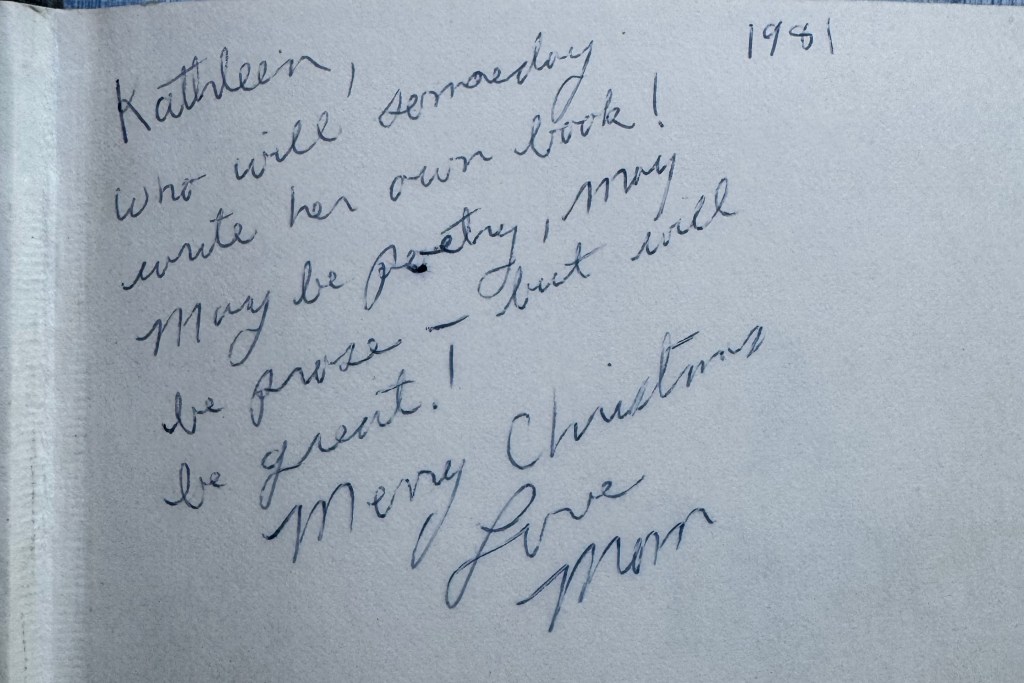
    The other day I was browsing through my bookshelves for suitable vacation reads when I came across my childhood copy of Shel Silverstein’s A Light in the Attic. I flipped it open and there, on the flyleaf, was my mom’s familiar handwriting: It was dated 1981.

    For Kathleen, who will someday write her own book!  May be poetry, may be prose —but will be great! Merry Christmas Love, Mom

    I had won some sort of writing competition at Somerset Junior High earlier that year.* There was an evening ceremony where I was presented with a Webster’s dictionary for my efforts, along with an appropriately fancy certificate. Both are long gone now. But, boy, was my mom excited.

    In truth, she was far more excited than I was.  I was so fucking awkward in seventh grade that the last thing I wanted to do was walk across the gymnasium and shake hands with my creative writing teacher and the principal. I was convinced this was yet another nail in my popularity coffin. But mom beamed proudly through the awards ceremony and even dragged my dad along.

    At Christmas the book of poetry was wrapped and waiting under our tree. I was a huge Shel Silverstein fan after three consecutive years of Mr. O’Grady’s language arts classes in elementary school. Mr. O’Grady read all sorts of novels to us, but he read from Silverstein’s Where the Sidewalk Ends like it was scripture. Regularly, reverently. I promise you, every single kid who had Mr. O’Grady at Standiford School knows who Sarah Cynthia Sylvia Stout is. My own copy of the newly published Light in the Attic was way cooler than winning the award. And, yeah, I still have the book.

    Fast forward thirty-five years. My mom is in the local emergency room, her third or fourth visit in a two-month span. She has congestive heart failure, and this isn’t going to end well for her and we all know it. These regular trips to the ER were stressful and frightening for all of us, but especially my mom, who was in a showdown with her own mortality. I remember following her into the house after one of these ER stays. She was moving slowly, gingerly, and suddenly she stopped altogether. “This is harder than I thought it would be” is all she said. She didn’t elaborate.  She didn’t even turn around to look at me. She didn’t have to. She was talking about dying. Dying was harder than she thought it would be.

    Anyway, I remember this ER visit specifically, because we were in a room by ourselves, my mom hooked up to a line of medical equipment and me sitting on the bed next to her. We sat in silence for awhile, just listening to the rhythmic beeps and sighs of the machines. Suddenly she reached over, grabbed my arm, and whispered something urgently. I had to lean down close and ask her to repeat what she said.

    “I want you to write a book.”

    Nothing can prepare you for these moments in your life. If there had been a manual to read or a workshop to attend, I might have had the wherewithal to respond gently, affirmatively. Instead, I leapt away from the bed like it was on fire. “Oh no you fucking don’t!” Mom closed her eyes in response. “Hey,” I said, squeezing her shoulder, “HEY. You are not going to die right now with your last wish being for me to write a book! Do. Not. Do. That. To. Me.” Her eyes still closed, my mom managed to smile. Then a doctor appeared to work their magic and soon we were on our way home again. Her dying-not-dying wish forgotten by her, I’m sure. But not by me. Never by me.

    I’m starting this blog because I don’t have a book in me, at least not yet. But I just might have a blog.

    This is for you, mom.

    *The story was called “Sundays.” It was a post-apocalyptic tale of a world where we had so badly screwed up the ozone layer – ozone was a big deal back then – that the sun’s radiation had become hostile and dangerous. There were only a few days a year – days carefully calculated by climate scientists – where what was left of the ozone layer would drift over where you lived and everyone could go outside for a spell. Even then you needed special glasses and clothing, or the sunlight could kill you. There was some weird ritual involved in sun days (I’m sure I was trying to be all Shirley Jackson), and everyone’s parents would try to be festive but they were totally faking it because they remembered the days when you could just, like, play in the sunshine every day. And the kids knew their parents were sad and so would themselves try to be festive, but deep down they were sad, too, because they never could just play in the sunshine. So, remember this happy tale the next time you read an article about “kids today” having a bleak view of the future. Gen X was no slouch.

  • Melodious Thoughts: What’s in a Name? (Fall 2026)

    This blog is not about music, though I do have a crazy, quasi-spiritual connection to music and reserve the right to write about that on occasion. I have for a long time wrestled with writing something about my favorite playlist, an ever-evolving, wildly varied collection of songs titled Spirituals. But, alas, I haven’t found the way into that piece yet and I’m no good at forcing open the doors of creativity. So, no, this blog is not about music.

    Nor are the ideas expressed herein necessarily melodious. I wouldn’t describe my writing as particularly mindful or relaxing, the sort of thing you dip into before bed to improve your sleep duration or quality. I’m no L. M. Montgomery. Although I frequently find myself swimming in the waters of childhood nostalgia, sometimes those waters can be choppy.


    This blog is simply named after a line in one of my favorite sections of one of my favorite poems, Walt Whitman’s “Song of the Open Road.” Here’s the bit with the melodious thoughts, it’s from section 7:

    These yearnings why are they? these thoughts in the darkness why are they?
    Why are there men and women that while they are nigh me the sunlight expands my blood?
    Why when they leave me do my pennants of joy sink flat and lank?
    Why are there trees I never walk under but large and melodious thoughts descend upon me?
    (I think they hang there winter and summer on those trees and always drop fruit as I pass)
    [1]:

    I have a long, rich history with Mr. Whitman. In the spring of 1990, I transferred as an English major from MJC to CSU, Stanislaus. I enrolled in a beginning acting course and three literature courses, including a section of Paul Reuben’s Major American Authors. On the very first day of class, Reuben assigned a research paper on an American author as our culminating class project. We were to work on this paper all semester and were expected to engage in considerable research beyond our textbook and class notes. There was a list of authors to choose from, and Reuben encouraged us to sign up early because it was strictly a one-author-per-student situation. He waved the list in front of us enticingly. After class students crowded around the list, which, in 1990, was an actual paper document Reuben had spread out on his podium.

    By the time I fought my way to the podium the only author I had any real experience with – William Faulkner – was already claimed. I scanned through the list several times, but I was at a loss. My imposter syndrome flared: what kind of English major was I? Who were these authors? At MJC I had taken both my beginning and advanced composition courses from the same professor, Henry Hahn. Mr. Hahn had an abiding love for what I like to call “place-based, savage American pastoralism.” Don’t bother looking this up; I’m pretty sure I’m the only one who calls it that. Whatever the official genre is called, for two consecutive semesters I had immersed myself in the writings of Edward Abbey, Annie Dillard, and Robinson Jeffers. None of their names were on Reuben’s list. Feeling desperate, I put my name next to Ralph Waldo Emerson. Wasn’t he sort of a non-conformist? And didn’t he write a book titled Nature? Maybe he would have some cool Edward Abbey vibes?

    As it turns out, I am not an Emerson fan. Reading him was like pulling teeth for me. Reading about him was easier, and generally I felt his ideas were cool. But getting to those ideas? Reading Emerson for me is like listening to jazz: I understand why it’s good, I just don’t enjoy it. It’s too heady. I enjoy art more when I experience it through the gut or – even better – through the loins. Can we just leave my sad little underdeveloped intellect out of it, please?

    In John Jay Chapman’s 1899 essay, “Emerson,” which I dutifully read as part of my research, these words struck a chord with me:

    “Human sentiment was known to Emerson mainly in the form of pain. His nature shunned it; he cast it off as quickly as possible.”[2]


    If you know me, I am basically a walking mass of human sentiment. I credit Chapman for making me finally admit I had made the worst possible choice for my research topic. I actually dredge up this experience as an example when, as an academic research librarian, I’m invited to colleagues’ classrooms to talk about the importance of well-reasoned topic selection. As in: don’t choose blindly; don’t let what happened to me happen to you.

    My love affair with Whitman might have been a reaction to Emerson. It’s not the first time I’ve overcorrected when it comes to men. It might also be related to me starting to fall for my first husband, who was not only enrolled in that American Authors class with me, but a regular fixture in the theater department where I went three days a week for my acting class. All I know is I was innocently sitting in class one day when Professor Reuben decided to read to us the opening pages of “Song of Myself.” I’m including a selection of those lines here, though I don’t really expect you to read them all. But if you ARE so inclined, I wildly encourage you to read them aloud.


    Houses and rooms are full of perfumes, the shelves are crowded with
    perfumes,

    I breathe the fragrance myself and know it and like it,
    The distillation would intoxicate me also, but I shall not let it.

    The atmosphere is not a perfume, it has no taste of the distillation, it is
    odorle
    ss,
    It is for my mouth forever, I am in love with it,
    I will go to the bank by
    the wood and become undisguised and naked,
    I am mad for it to be in con
    tact with me.

    The smoke of my own breath,
    Echoes, ripples, buzz’d whispers, love-root, silk-thread, crotch and vine,
    My respiration and inspiration, the beating of my heart, the passing of blood
    and air through my lungs,
    The sniff of green leaves and dry leaves, and of the shore and dark-color’d
    sea-rocks, and of hay in the barn,
    The sound of the belch’d words of my voice loos’d to the eddies of the wind,
    A few light kisses, a few embraces, a reaching around of arms,
    The play of shine and shade on the trees as the supple boughs wag,
    The delight alone or in the rush of the streets, or along the fields and hill-sides,
    The feeling of health, the full-noon trill, the song of me rising from bed and
    meeting the sun.


    It is for my mouth forever, I am in love with it? The smoke of my own breath, echoes, ripples, buzz’d whispers, love-root, silk-thread, crotch and vine? Seriously? This is not jazz. This is not the shunning of human sentiment. This IS human sentiment. All the humans. All the sentiment. Even read aloud by my middle-aged, paunchy professor in his thick Indian accent, Whitman, to me, was sex, drugs, and rock and roll all rolled up into one perfect package. I actually cried. I felt released to feel after being all boxed up by Emerson.


    After class I requested to change authors for the final project. Reuben didn’t want to let me do it, as half the semester had passed and he worried I wouldn’t have time to change lanes so suddenly. But my adamance, my streaked mascara, my argument that my grounding in transcendentalism would transition me smoothly from the arms of Ralph to Walt finally worked. And the rest, as they say, is history.

    By the way, John Jay Chapman wrote an essay on Walt Whitman, too. I think Chapman and I see eye-to-eye on the mind-gut-loin continuum. Chapman says of Whitman,

    His mind seems to be submerged and to have become almost a part of his body. The utter lack of concentration which resulted from living his whole life in the open air has left him spontaneous and unaccountable.[4]


    I don’t know about you, but being spontaneous and unaccountable sounds – as our kids used to say, “goals as fuck.” And speaking of goals, Chapman concludes his essay on Whitman with this verdict:

    He was neither chaste, nor industrious, nor religious. He patiently lived upon cold pie and tramped the earth in triumph.[5]


    A few months back I cued up an audio version of “Song of the Open Road.” It was right around the time I was trying to figure out what to call my blog, and I wanted to hear the poem again. Not just read it, but hear it. Russell and I listened to it in its entirety as we drove out of the harbor that morning, and by the time we arrived at the onramp, we were both quietly sobbing. Turns out Whitman takes on a whole new significance when you’ve been traveling down the open road for a few decades.


    Listen! I will be honest with you,
    I do not offer the old smooth prizes, but offer rough new prizes,
    These are the days that must happen to you:
    You shall not heap up what is call'd riches,
    You shall scatter with lavish hand all that you earn or achieve,
    You but arrive at the city to which you were destin'd, you hardly settle yourself to satisfaction before you are call'd by an irresistible call to depart. [6]


    So what is this blog about? It’s about so many things: thrift stores and libraries, reading books and poems, watching movies and plays, listening to music and podcasts, loving pets and loving people. It’s about the past, the future, and the here and now. It’s about the places I go as I tramp the earth in triumph and the rough new prizes I’m finding in middle age. It’s about all the large, small, profound, mundane, and, yes, occasionally melodious thoughts that descend when I’m walking under the oak canopy with Otis. So pull up a seat. And watch out for falling fruit.


    [1] Whitman, Walt. “Song of the Open Road.” This poem is in the public domain and available all over the internet. I used the version on the Whitman Archive: https://whitmanarchive.org/item/ppp.00707_00790

    [2] Chapman, John Jay. “Emerson,” from Emerson and Other Essays (1899). Available in full at Project Gutenberg. https://www.gutenberg.org/cache/epub/13088/pg13088-images.html

    [3] Whitman, Walt. “Song of Myself.”

    [4] Chapman, John Jay. “Emerson,” from Emerson and Other Essays (1899).

    [5] ibid

    [6] Whitman, Walt. “Song of the Open Road.” This poem is in the public domain and available all over the internet. I used the version on the Whitman Archive: https://whitmanarchive.org/item/ppp.00707_00790

  • Feral Thrifting (1979 – 2026)

    I’m spending the summer in Paris, my third such summer in the last 6 years. It’s a long, strange trip that shaped me into a regular visitor to the City of Light, and some day I’ll likely share the details of that journey. However it happened, here I am, curled up on a couch in a pleasantly dilapidated apartment building in the 8th arrondissement.

    My daughter Molly will be arriving for a visit next week, and we have big thrifting plans. While other mother-daughter duos make their Parisian pilgrimages to Galeries Lafayette, the Bon Marché, and Hermès, we will be scouring the city for second-hand treasures. I’ve made a checklist of 44 thrift stores in the greater metropolitan area. And to be clear, there are no designer thrift stores on this list. You see, Molly and I are feral thrifters.

    Curation plays no role in feral thrifting. The kind of thrifting we like doesn’t happen in upscale consignment shops, vintage stores, or resale boutiques. There is nothing wrong with this sort of second-hand shopping, of course, and for many it’s the only acceptable option. It’s just not feral.

    Feral thrifting takes place in feral stores. The kinds of places where people pull up in back alleys, open their trunks, and start piling boxes and bags of unwanted goods onto a loading dock. Maybe their closets grew too full, their bodies too large or too small, their hemlines too outdated. Perhaps they painted their living room a different color or bought a new sectional and none of this stuff matched anymore. Maybe their mother died and after a year of enshrining her belongings in the garage they awoke one morning to find the grief had shifted just enough for them to move on. Marie Kondo, I’m certain, has inspired and will continue to inspire legions of folks to haul trunks full of joyless goods down to their local charity’s retail arm.

    Whatever the motivation, people are booting all sorts of perfect, imperfect, immaculate, soiled, whole and broken objects out of their lives and onto that loading dock, raw and uncut, history clinging to every item like a scent. Within days – possibly even hours — it will be on the shelves and ready for us.  

    We are feral, too. We like the way history smells: smoky, musky, slightly sweet. Google “thrift store smell reddit” and you will find hundreds of people sharing their distaste for the scent of thrift stores and trying to get to the bottom of why all thrift stores smell the same. I’m always surprised at how many people think this smell comes from a detergent or disinfectant. Wishful thinking maybe.

    Like Soylent Green, the ubiquitous scent in your local Goodwill is PEOPLE, people. I understand why the general populace finds it repellant, the stink of humanity is not typically listed as a selling point. But, for me, walking into the familiar smell of my local Salvation Army is as evocative as walking into my grandmother’s kitchen 50 years ago. Comforting and full of promise.

    Many of my friends tell me they “don’t have the patience” for thrift store shopping. Or that they “never find anything.” Yes, patience is required. The patience of a hunter. And if you’re not finding anything it’s because you’re not looking at absolutely everything. Yes, you really may need to paw through that entire bin of frayed scarves for the single silken reward; to shuffle through long racks of coats like a blackjack dealer – quick and thorough – to find your cashmere or camelhair prize. Thrifting is Easter egg hunting for grown-ups. A variable reward extravaganza, your brain flooding with sweet dopamine when you unearth those soft leather boots from the box of worn footwear.

    Garage sales were my gateway into thrifting. I started my love affair with garage sales at a very young age, back when we rode bicycles around the neighborhood all summer long and had pockets full of allowance money to spend. I could ride to Quik Stop and buy a Big Hunk for a quarter in 1979, or I could stop by the garage sale down the street and come home with an electric card shuffler, a rabbit foot keychain, or a slightly-used Yo-Yo that lit up as it spun. As young as age 10 I fully recognized and appreciated these amazing bargains.

    A voyeur by nature, garage sales were also an efficient way to investigate the lives of our neighbors. To see what books they read, what clothes they wore, what toys they had outgrown and tools they had replaced. I could live out my considerable Harriet the Spy ambitions and own a light-up Yo-Yo for the cost of a candy bar? Seriously, what’s not to love about that?

    When I was in junior college I spent a semester abroad, knocking off some general education units at the American Institute for Foreign Study in London. To stave off my considerable homesickness I would often roam the massive Portobello Road market after school. On Saturdays the antique vendors were out in full force, but on weekdays you’d get the normal folks selling a hodgepodge of clothing, jewelry, housewares, and books. Portobello Road on Tuesdays was a garage sale on steroids.

    I had emptier pockets as a college student, and the markets were less about buying and more about discovering. I was an archaeologist with an endless appetite for digging down into clothing racks, jewelry trays, and damp boxes full of jumbled bric-a-brac. I didn’t want to possess these things as much as I wanted to inventory them. 

    My school provided students with an array of low-cost travel opportunities, from day trips to Oxford to a homestay system allowing us to spend weekends with families all over England. I took advantage of these extracurricular options and then branched out to taking occasional weekend trips on my own or with a friend. Most of the towns in England have multiple charity shops on their high streets, and with the Portobello Road serving as my gateway drug, I started visiting them. Oxfam, British Heart Foundation, Cancer Research UK, Barnardos. By the time I returned home to California I was hooked.