
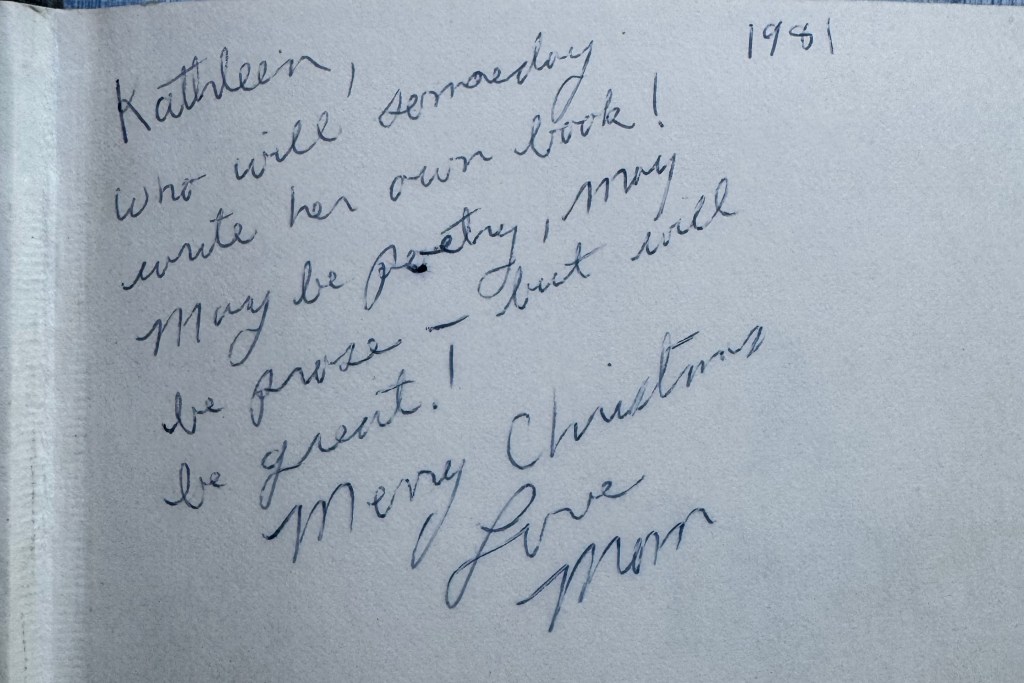
The other day I was browsing through my bookshelves for suitable vacation reads when I came across my childhood copy of Shel Silverstein’s A Light in the Attic. I flipped it open and there, on the flyleaf, was my mom’s familiar handwriting:
For Kathleen, who will someday write her own book! May be poetry, may be prose —but will be great! Merry Christmas Love, Mom
It was dated 1981. I had won some sort of writing competition at Somerset Junior High earlier that year.* There was an evening ceremony where I was presented with a Webster’s dictionary for my efforts, along with an appropriately fancy certificate. Both are long gone now. But, boy, was my mom excited.
In truth, she was far more excited than I was. I was so fucking awkward in seventh grade that the last thing I wanted to do was walk across the gymnasium and shake hands with my creative writing teacher and the principal. I was convinced this was yet another nail in my popularity coffin. But mom beamed proudly through the awards ceremony and even dragged my dad along.
At Christmas the book of poetry was wrapped and waiting under our tree. I was a huge Shel Silverstein fan after three consecutive years of Mr. O’Grady’s language arts classes in elementary school. Mr. O’Grady read all sorts of novels to us, but he read from Silverstein’s Where the Sidewalk Ends like it was scripture. Regularly, reverently. I promise you, every single kid who had Mr. O’Grady at Standiford School knows who Sarah Cynthia Sylvia Stout is. My own copy of the newly published Light in the Attic was way cooler than winning the award. And, yeah, I still have the book.
Fast forward thirty-five years. My mom is in the local emergency room, her third or fourth visit in a two-month span. She has congestive heart failure, and this isn’t going to end well for her and we all know it. These regular trips to the ER were stressful and frightening for all of us, but especially my mom. She was in a showdown with her own mortality. I remember following her into the house after one of these ER stays. She was moving slowly, gingerly, and suddenly she stopped altogether. “This is harder than I thought it would be” is all she said. She didn’t elaborate. She didn’t even turn around to look at me. She didn’t have to.
Anyway, I remember this ER visit specifically, because we were in a room by ourselves, my mom hooked up to a line of medical equipment and me sitting on the bed next to her. We sat in silence for awhile, just listening to the rhythmic beeps and sighs of the machines. Suddenly she reached over, grabbed my arm, and whispered something urgently. I had to lean down close and ask her to repeat what she said.
“I want you to write a book.”
Nothing can prepare you for these moments in your life. If there had been a manual to read or a workshop to attend, I might have had the wherewithal to respond gently, affirmatively. Instead, I leapt away from the bed like it was on fire. “Oh no you fucking don’t!” Mom closed her eyes in response. “Hey,” I said, squeezing her shoulder, “HEY. You are not going to die right now with your last wish being for me to write a book! Do. Not. Do. That. To. Me.” Her eyes still closed, my mom managed to smile. Then a doctor appeared to work their magic and soon we were on our way home again. Her dying-not-dying wish forgotten by her, I’m sure. But not by me.
I’m starting this blog because I don’t have a book in me, at least not yet. But I just might have a blog.
This is for you, mom.
*The story was called “Sundays.” To the best of my memory, was a post-apocalyptic tale of a world where we had so badly screwed up the ozone layer – ozone was a big deal back then – that the sun’s radiation had become hostile and dangerous. There were only a few days a year – days carefully calculated by climate scientists – where what was left of the ozone layer would drift over where you lived and everyone could go outside for a spell. Even then you needed special glasses and clothing, or the sunlight could kill you. There was some weird ritual involved in sun days, and parents would try to be festive but they were totally faking it because they remembered the days when you could just, like, play in the sunshine every day. And the kids knew their parents were sad and so would themselves try to be festive, but deep down they were sad, too, because they never could just play in the sunshine. So, remember this happy tale the next time you read an article about kids today having a bleak view of the future.
 Melodious Thoughts
Leave a comment